hello@yurtinthedirt.com.au
 +61 489 269 088


 0 Comments
 Share
Share
Council Approval for Yurts in Australia & NZ: What You Actually Need to Know (2026)
If you’ve been Googling “do yurts need council approval in Australia,” you’ve probably read a dozen articles that either tell you absolutely nothing useful, or confidently state rules that turn out to be completely wrong for your specific situation.
Here’s the honest reality: there is no single national answer. But that doesn’t mean you’re flying blind. At Yurt in the Dirt, we’ve helped clients across every Australian state and New Zealand navigate this — and there are clear patterns in how councils think about these structures. This guide walks you through what actually matters.
The short answer: It depends on what you’re using it for, where your land is zoned, and whether you’re connecting services. A backyard studio on rural land is a very different conversation to a commercial glamping business or a full-time home. Read on for the breakdown.
1. How Councils Actually Think About Yurts
Most councils don’t have a specific “yurt” category. They try to fit it into an existing classification, and the classification they land on determines everything about your approval pathway. The three most common classifications are:
If the yurt is not permanently fixed to the ground, isn’t hard-plumbed, and is under a certain size, some councils treat it as a temporary structure — similar to a large tent. In these cases, the deck it sits on may be the only thing that needs formal approval. We have clients who’ve gone down this path successfully. It’s not guaranteed, but it’s more common than people think, particularly on rural land.
A yurt used as a yoga studio, art space, therapy room, farm office, or guest overflow — and presented that way — often follows a much simpler pathway than one framed as accommodation or a home. The key word here is “non-habitable.” On paper, you’re not sleeping in it. This is a legitimate and commonly used pathway, and it’s one reason the language you use when approaching council matters enormously.
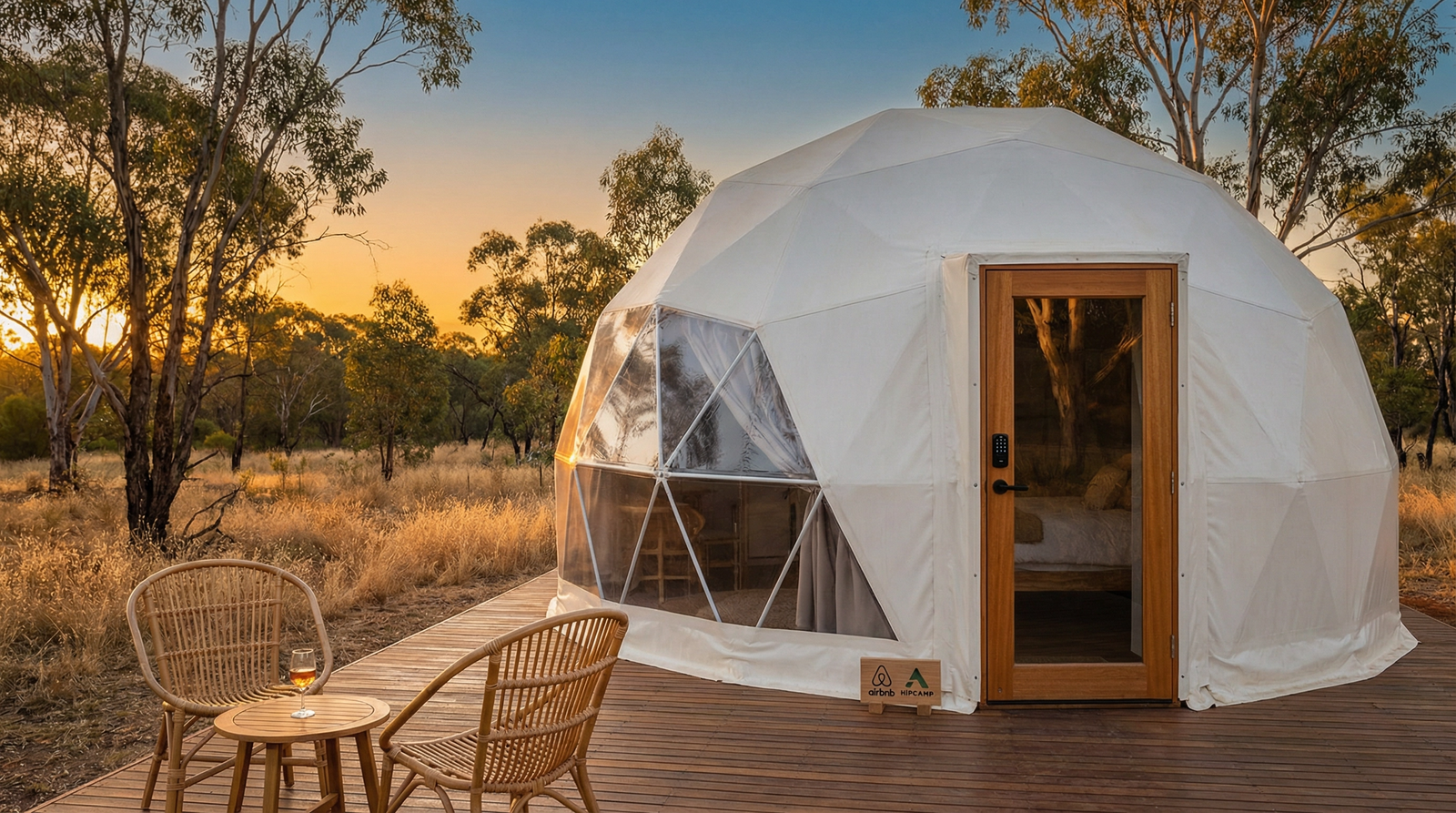
The moment you’re renting it out on Airbnb or Hipcamp, or presenting it as permanent accommodation, you’re in a different category entirely. This is where formal approvals, fire ratings, wastewater plans, and sometimes bushfire assessments come into play. It’s more work, but it’s absolutely achievable — we have clients operating fully approved glamping sites across Australia.
2. The 3 Things That Change Your Approval Pathway
Across every state and every council, the same three variables keep coming up as the real deciding factors:
| Variable | Lower Risk | Higher Scrutiny |
|---|---|---|
| Intended Use | Studio, yoga space, seasonal retreat, guest overflow | Full-time dwelling, commercial Airbnb, multi-unit glamping |
| Land Zoning | Rural, agricultural, lifestyle acreage | Residential suburban, environmental conservation zones |
| Services Connected | Off-grid, composting toilet, rainwater, solar | Hard-plumbed water, mains sewer, permanent electrical |
The more your setup sits in the left column, the easier the conversation with council tends to be. The more it drifts right, the more formal the process becomes.
3. State-by-State: What We’re Seeing in 2026
These aren’t definitive legal rulings — planning rules change and council interpretation varies. But this is the real-world picture based on what our clients across Australia are experiencing right now.
New South Wales (NSW)
NSW has one of the more complex planning systems, but rural zones (RU1 Primary Production, RU2 Rural Landscape) tend to be the most workable for yurts and domes. Smaller structures used as non-habitable studios can sometimes qualify as exempt development under the State Environmental Planning Policy, meaning no DA is required at all.
For commercial glamping or eco-tourism, you’ll typically need a Development Application (DA). The key is framing it as an “eco-retreat” or “farm-stay” the language genuinely matters. Metro and coastal councils tend to be stricter than inland rural ones.
Victoria (VIC)
Victoria uses Planning Permits rather than DAs. Yurts on rural land are often classified as “moveable dwellings” or “tents” if they’re not permanently fixed — which can simplify the process significantly. Councils in the Yarra Ranges, Mornington Peninsula, and Gippsland have seen enough glamping applications now that they’re generally familiar with the concept.
If your land is in a Bushfire Management Overlay (BMO), you’ll need a Bushfire Management Statement regardless of the structure type. This is non-negotiable in VIC and worth factoring into your planning timeline.
Queensland (QLD)
QLD is generally the most glamping-friendly state. Many rural councils actively encourage agritourism and nature-based tourism. For commercial use, you’ll typically need a Material Change of Use (MCU) for “Tourist Accommodation” — but in rural zones this is often a relatively straightforward process.
Some councils have specific “Nature Based Tourism” codes that make small-scale setups (a couple of yurts on a farm) genuinely manageable. It’s worth a pre-lodgement chat with your local council before you spend anything.
Western Australia (WA)
WA has a useful pathway for glamping operators through the Caravan Parks and Camping Grounds Act — specifically the “Nature Based Park” licence. This classification was designed for low-impact, eco-friendly accommodation and tends to have more relaxed standards around sealed roads and permanent ablution blocks than a standard caravan park licence.
Regional WA councils are generally more flexible than metro Perth councils. We have clients operating approved yurt sites in the South West and Margaret River region — it’s very achievable with the right approach.
South Australia (SA) & Tasmania (TAS)
Both states can be workable, particularly for non-dwelling uses on rural land. SA uses a development approval system similar to NSW. Tasmania tends to have a more relaxed attitude toward alternative structures in rural and agricultural zones, though this varies by council.
In both states, the classification of the structure — studio vs accommodation vs dwelling — matters more than the fact that it’s a yurt. Get clear on your use case before you approach council.
4. New Zealand: A Slightly Different Picture
NZ operates under the Building Act 2004 and the Resource Management Act 1991 — two separate consent processes that can both apply to a yurt depending on your situation.
Building Consent (NZ)
Building consent deals with the structure itself — does it meet the NZ Building Code? Yurts under 30sqm (roughly a 6m yurt) that aren’t connected to services and aren’t used as permanent dwellings can often be built without building consent. As of 2026, new rules also allow standalone dwellings up to 70sqm to be built without building consent if a Licensed Building Practitioner signs off.
However — and this is important — not needing building consent doesn’t mean you’re exempt from the Building Code. You still need to comply; you just don’t need a council inspector to sign it off.
Resource Consent (NZ)
Resource consent deals with what you want to do and where — your zoning, land use, setbacks, and site coverage. Whether you need resource consent depends on your District Plan. Rural zones in Canterbury, Waikato, and Otago tend to be more permissive for alternative structures than urban or coastal zones.
If you’re running a commercial glamping operation, resource consent is almost always required. The good news is that NZ councils are generally familiar with the concept — eco-tourism is a significant part of the NZ economy and councils tend to be more receptive than you might expect.
NZ tip: The NZ government’s canibuildit.govt.nz tool is a genuinely useful starting point for understanding what consents might apply to your site before you pick up the phone to council.
5. Commercial Glamping: What Full Approvals Actually Look Like
If you’re setting up a proper glamping business — multiple yurts, paying guests, the whole thing — the approval process is more involved but it’s very much achievable. Here’s what a full commercial approval typically involves:
- Development Application or Planning Permit — lodged with your local council, usually including a Statement of Environmental Effects or equivalent.
- Bushfire Attack Level (BAL) Assessment — required if your land is in a bushfire prone area. This determines what fire-resistant standards your structures need to meet.
- Wastewater Management Plan — councils want to know how you’re handling toilet and shower waste for paying guests. Composting toilets can simplify this significantly.
- Site Plans — showing where each yurt sits on the land, access routes, setbacks from boundaries, and any existing structures.
- Structural Documentation — this is where we come in. We provide engineered deck plans, fabric fire ratings, and structural specifications that councils ask for.
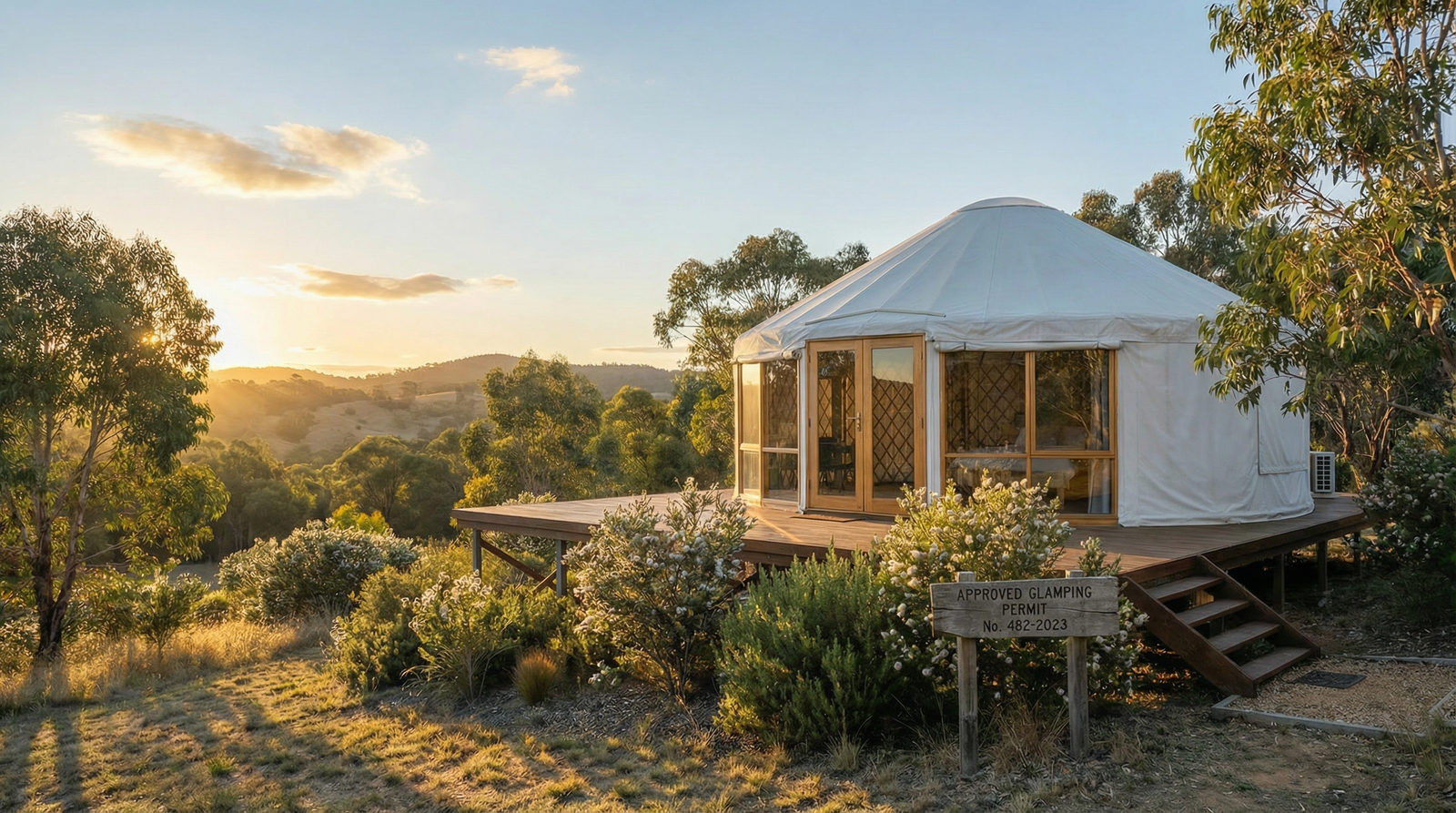
We have clients operating with full approvals — including BAL 29 bushfire-rated sites — running 6 to 9 yurts and making over $300 per night per structure. It takes time and planning, but the business case is strong. See what’s possible at Yurts at Yelverton in Margaret River.
We Help With More Than Just the Yurt
We provide the engineered deck plans, fabric fire ratings, and structural specs your council will ask for. Talk to us before you approach council — it makes the whole process smoother.
Or call us: +61 489 269 088
6. How to Approach Your Council Without Shooting Yourself in the Foot
The language you use when you first contact council matters more than most people realise. Walking in and saying “I want to live in a tent” is a very different conversation to “I’m looking at placing a non-habitable ancillary studio on my rural property.” Same structure, completely different reaction.
A few things that consistently help our clients:
Most councils offer a free 30-minute pre-lodgement meeting with a duty planner. Use it. Ask: “What would I need to provide to support an eco-tourism or ancillary structure application on this site?” You’ll learn exactly what reports they want before you spend a cent on consultants.
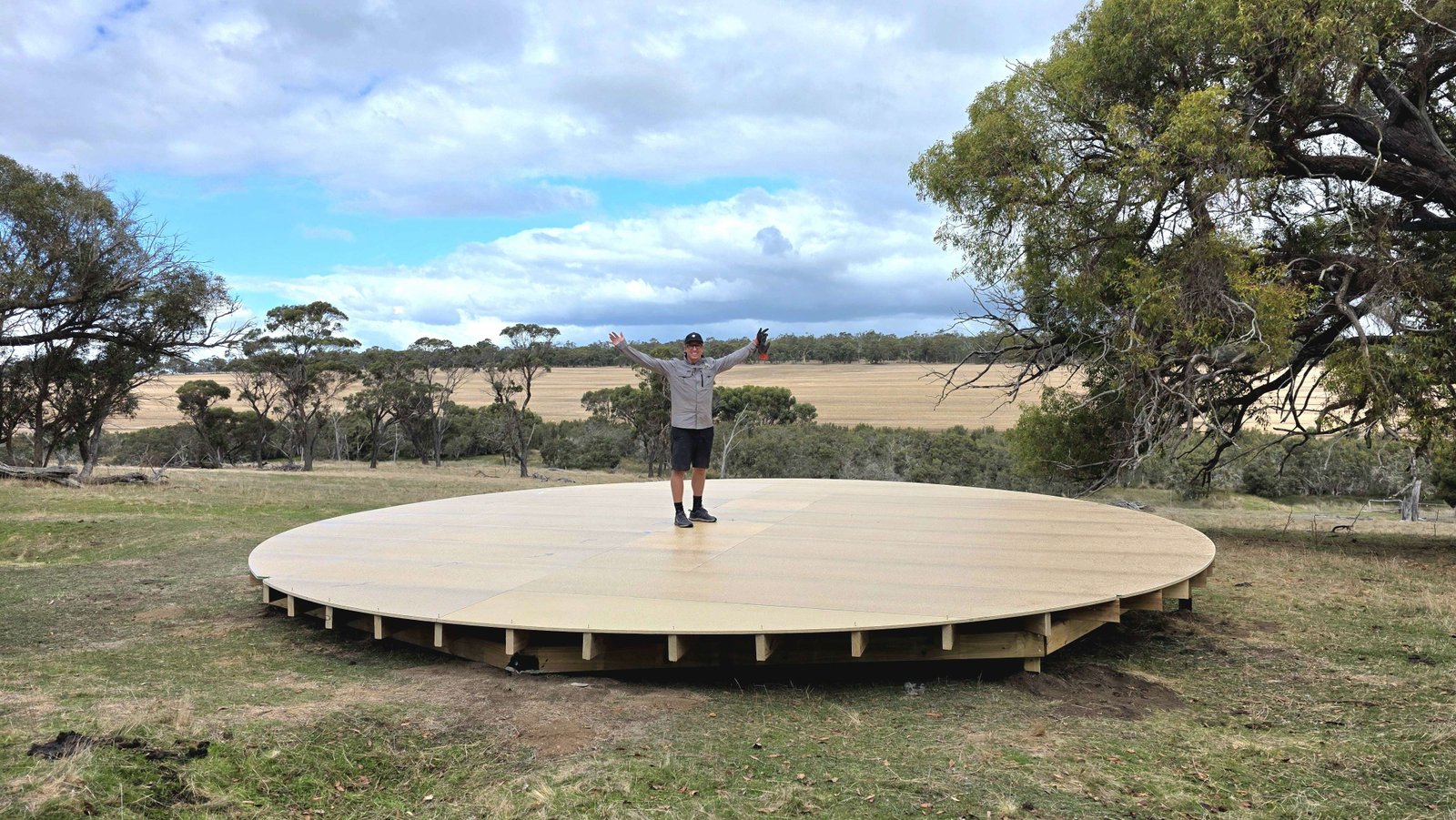
Councils understand timber decks. They approve them all the time. Frame it as: “I’m building a compliant engineered timber deck, and placing a temporary canvas structure on top of it.” The deck is the permanent structure. The yurt is the temporary cover. This framing is legitimate and it works.
Councils worry about sewage. If you can say “we’re installing an EPA-approved composting toilet and a greywater trench,” you remove one of their biggest concerns immediately. It also avoids the cost and complexity of an engineered septic system.
7. Frequently Asked Questions
Do yurts need council approval in Australia?
Not always. For private use on rural land — a studio, yoga space, or seasonal retreat — many clients set up without formal approvals, particularly where the yurt is treated as a temporary structure on an approved deck. For commercial use or full-time living, some form of approval is almost always required. The exact pathway depends on your state, council, and intended use.
Can I live in a yurt full-time in Australia?
Plenty of people do — but it’s not a guaranteed green light anywhere in Australia. Most councils won’t formally approve a yurt as a permanent dwelling under the National Construction Code. What many clients do instead is use it as temporary accommodation on rural land, or as a secondary structure while a main dwelling exists on the property. It carries some risk, and you need to understand your local area. We’re happy to talk through what others in similar situations have done.
What does council approval for a glamping yurt cost?
For a full commercial approval, budget somewhere in the range of $3,000–$8,000 for the process — covering council lodgement fees, a bushfire report if required, a wastewater assessment, and basic site plans. A local town planner is worth considering if you’re setting up a multi-yurt business; their knowledge of what the council wants to see can save you months of back-and-forth.
How long does council approval take?
For a standard DA or planning permit, allow 8–16 weeks from lodgement. If the council requests more information, the clock stops until you respond. Starting the conversation early — before you’ve ordered anything — gives you the most flexibility.
Do yurts need council approval in New Zealand?
It depends on the size, use, and whether services are connected. Yurts under 30sqm that aren’t used as permanent dwellings and aren’t connected to plumbing can often be built without building consent. However, resource consent under your District Plan may still apply, particularly for commercial use. NZ’s canibuildit.govt.nz tool is a good starting point.
Does Yurt in the Dirt help with the approval process?
Yes. We don’t just sell you a structure and leave you to figure out the paperwork. We provide engineered deck plans, fabric fire ratings, and structural documentation that councils ask for. We’ve also helped hundreds of clients understand what approach is likely to work for their specific land and goals. Talk to us before you approach council — it makes a real difference.
Get the Ultimate Buyer’s Guide
Stop guessing and start building. Our step-by-step guide covers everything from picking the perfect size to building your deck — plus, claim your $500 discount inside!
 0 Comments
 Share
Share
 By Ryan Smith