hello@yurtinthedirt.com.au
 +61 489 269 088


This is the question we get asked more than any other. The honest reality is that there is no single rule for the whole country, and planning rules and council interpretation change. What we can give you is the framework councils use, and how to have the conversation well.
How do councils look at a yurt?
Most councils do not have a "yurt" category. They decide which existing category your yurt fits, such as a shed, a studio, a temporary structure, tourist accommodation or a dwelling, and apply those rules. That is why the same yurt can face very different paths in two shires.
What changes your approval pathway?
Three things: how you use it, how big it is and how permanent it is.
Use
A yoga studio, art space, farm office or guest overflow is usually treated very differently from a home or paid accommodation. Once guests pay to stay, expect more requirements, such as fire, wastewater and access.
Size
Smaller structures sometimes fall under simpler rules. The thresholds differ between councils and states, so ask what applies to you.
Permanence
Whether the yurt is fixed to the ground, plumbed in, or connected to power can change how it is classed. The deck it sits on may be assessed on its own.
Is it different in each state?
Yes. Each state has its own planning system and each council applies it in its own way, so we do not give state-by-state rules here. Rural councils are often more familiar with yurts and glamping than metro ones, but always check with yours.
What about New Zealand?
New Zealand has its own building and resource consent system. Talk to your district or city council early, and we can help with the same letters and templates.
What if you want to run glamping?
Paid accommodation is its own category with more to cover. Our glamping permits guide walks through it for businesses, and how to start a glamping business covers the rest of the plan.
Can you live in a yurt with approval?
Our yurts and domes do not currently comply with Australian building standards for dwellings. You can live in a yurt in Australia, but that does not mean it will be approved as a permanent dwelling. Read can you live in a yurt in Australia for more.
How should you approach your council?
Talk to us first, then talk to your council early, before you buy or build. Describe what you are planning clearly and accurately.
Questions to ask your council:
- How would you classify a yurt used as (your use) on this zoning?
- Is there a size under which a structure is exempt or simpler to approve?
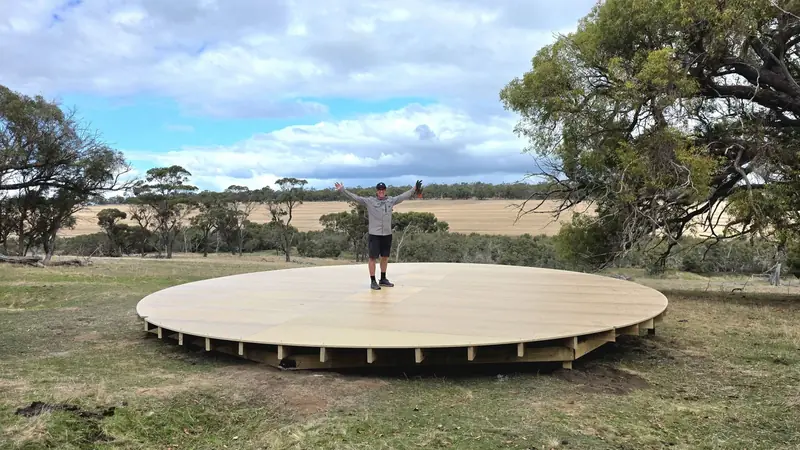
- Does the deck need approval on its own?
- Does connecting power, water or a toilet change anything?
- Are there bushfire, flood or heritage overlays on this block?
- What would you need to see in an application?
Ask for the answers in writing. Our platform guide helps if the deck is part of the conversation.
How can we help?
We can talk through your site and use, share the letters and templates other clients have used, and give you product details councils commonly ask for. Call our team on +61 489 269 088 before you lodge anything.
Frequently asked questions
Do yurts need council approval in Australia?
It depends on your council, your state, the size and how you'll use it. We've completed 150+ client builds, so check in with us first, as we can help you with the best way to approach council. We also have letters and templates that may assist.
Can I put a yurt on my rural land without approval?
For private use on rural land, such as a studio, yoga space or seasonal retreat, the pathway is often simpler. It depends on your council, your state, the size and how you'll use it. We've completed 150+ client builds, so check in with us first, as we can help you with the best way to approach council. We also have letters and templates that may assist.
Does the deck need approval?
Sometimes, even when the yurt itself is treated more simply. Ask your council about the deck separately.
Can I rent my yurt on Airbnb?
Paid accommodation usually has more requirements. See our glamping permits guide and talk to your council early.
Do you help with council paperwork?
Yes. We have letters and templates that may assist, and we can give you the product details councils usually ask for.
Talk to us before you talk to council
Tell us your site and what you are planning, and we will help you work out the best way to approach council.