hello@yurtinthedirt.com.au
 +61 489 269 088


 0 Comments
 Share
Share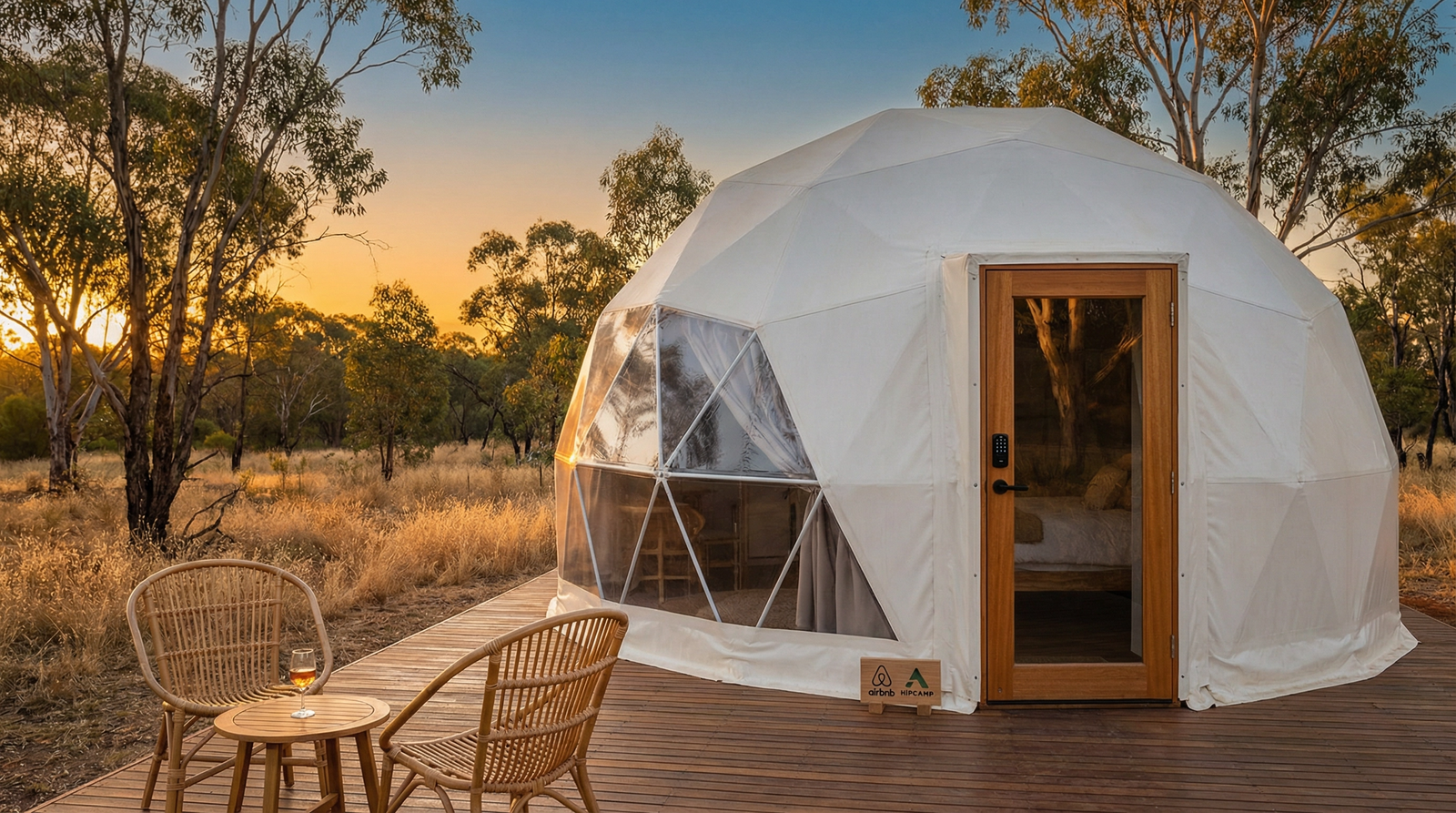
Glamping on Airbnb Australia: Complete Hipcamp & Host Guide 2026
Glamping on Airbnb Australia is one of the fastest-growing income opportunities for landowners with a yurt or geo dome — but knowing how to list, price, and optimise your property is what separates the hosts who get booked solid from those who sit empty.
This guide walks you through listing your glamping accommodation on Australia’s two biggest booking platforms — Airbnb and Hipcamp — so you can start earning sooner and stop leaving money on the table.
In this guide, we cover:
- Airbnb vs. Hipcamp — which platform suits your setup
- Step-by-step listing guides for both platforms
- Benchmark pricing across NSW, QLD, VIC, WA, and SA
- How to optimise your listing to stand out and get booked
- The legal side — council approvals and insurance
The Australian glamping market is booming. The industry was valued at AUD $110.5 million in 2025 and is projected to reach AUD $304 million by 2034 — a compound annual growth rate of nearly 12%.[1] Domestic travellers across NSW, QLD, VIC, WA, and SA are actively searching for unique, nature-based getaways, and a well-positioned yurt or dome can command $250–$400+ per night.
But even the most beautiful setup earns nothing without bookings. That’s where Airbnb and Hipcamp come in.
1. Airbnb vs. Hipcamp: Which Platform Suits Your Glamping Business?
Airbnb and Hipcamp are both excellent platforms for glamping hosts, but they attract different types of guests and work best for different setups. Understanding the distinction will help you decide where to invest your energy — and whether listing on both makes sense for your situation.
| Feature | Airbnb | Hipcamp |
|---|---|---|
| Primary Audience | Broad — travellers seeking unique accommodation | Niche — campers, overlanders, and nature lovers |
| Host Commission | ~3% (host-only fee model) | 10% of booking total |
| Guest Service Fee | ~14% added to guest total | ~10% added to guest total |
| Listing Focus | The accommodation itself (yurt, dome, cabin) | The land and the outdoor experience |
| Insurance | AirCover — up to USD $3M host damage protection | USD $1M host liability insurance per booking |
| Minimum Amenities | Guests expect hotel-like basics (bed, linen, wifi) | No minimum — rustic setups welcome |
| Calendar Sync | ✓ iCal sync available | ✓ iCal sync available |
| Photography Support | Paid professional photography in some regions | Free professional photography in many regions |
| Best Suited For | Luxury glamping with full amenities | Off-grid, rustic, and nature-immersive experiences |
Our recommendation: List on both. Airbnb gives you volume and global reach; Hipcamp gives you a highly targeted audience who already loves the outdoors. Many of our clients run both platforms simultaneously using calendar sync to avoid double-bookings.
2. How to List Your Glamping on Airbnb Australia
Airbnb is the world’s largest accommodation marketplace, and glamping is one of its fastest-growing categories. Listing your yurt or dome on Airbnb exposes you to millions of travellers — including international visitors to NSW, QLD, VIC, WA, and SA who are actively searching for something different.
Step-by-step: Creating your Airbnb listing
- Create or log into your Airbnb account at airbnb.com.au. Click Airbnb your home and select your property type. For a yurt or dome, choose Unique space then Tent or Dome.
- Set your location precisely. Guests need to know if they’re heading to the Hunter Valley, the Mornington Peninsula, or the Margaret River region. Accurate location data also helps Airbnb surface your listing in relevant searches.
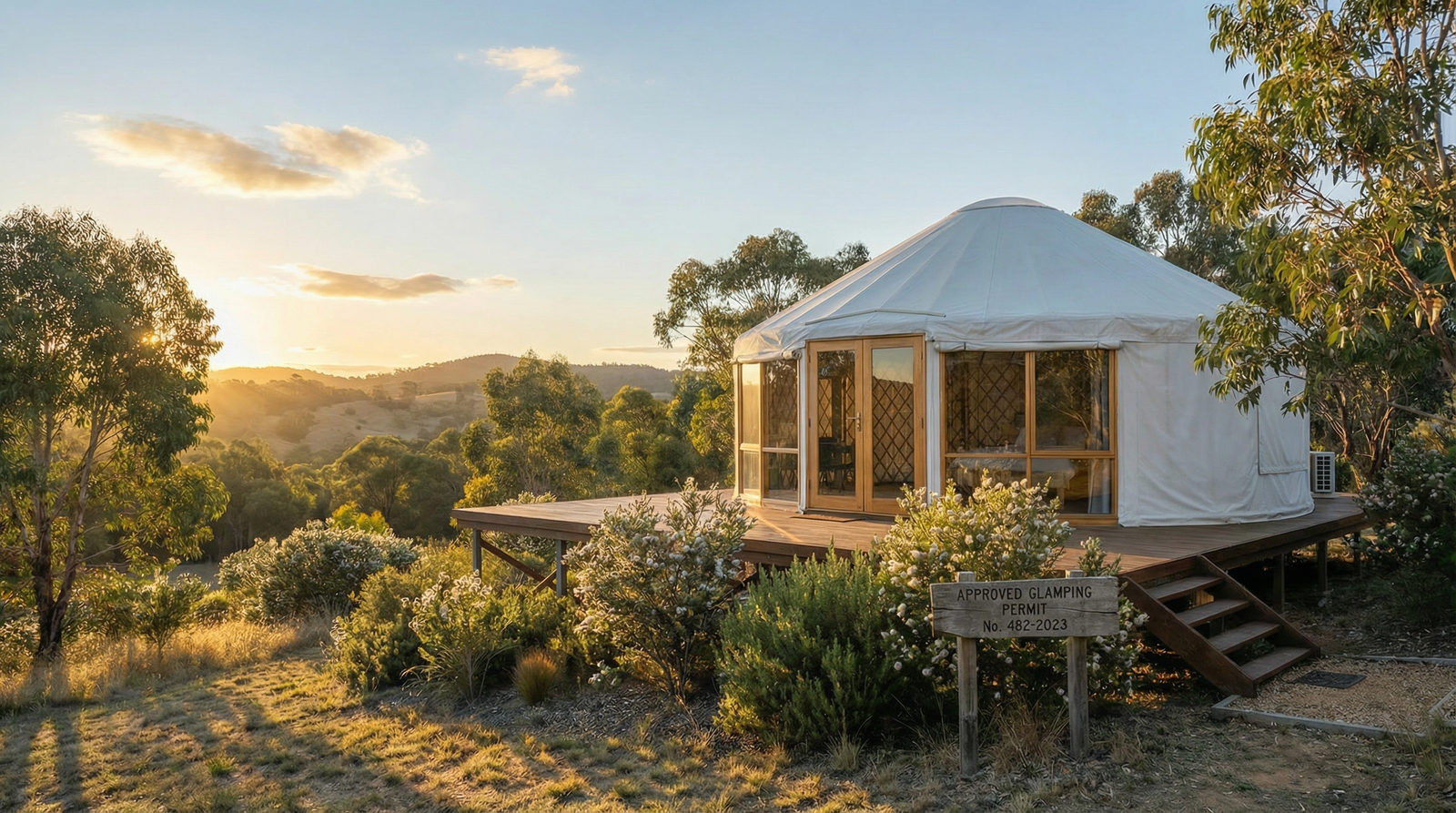
- Upload at least 15 high-quality photos. Airbnb’s algorithm rewards listings with more photos. Include exterior shots, interior shots, the bathroom, the view, and any unique features — fire pit, stargazing deck, outdoor bath.
- Write a compelling title and description. Your title has 50 characters — use them wisely. Something like “Secluded 8m Yurt with Outdoor Bath — Hunter Valley” outperforms a generic title every time.
- Set your amenities accurately. Be honest. If you have a composting toilet, list it. If you’re off-grid solar, say so. Guests who book knowing what to expect leave better reviews.
- Set your pricing. Use Airbnb’s Smart Pricing tool as a starting point, but review it manually. Most glamping yurts and domes in Australia perform best at $200–$380 per night, with premium locations commanding $400–$600+ on weekends and school holidays.
- Set your house rules and cancellation policy. A moderate cancellation policy tends to attract more bookings than strict. Clearly state rules around pets, fires, and quiet hours.
Airbnb SEO: Getting found in search
Airbnb’s search algorithm rewards listings that are complete, well-reviewed, and responsive. To rank higher in searches across NSW, QLD, VIC, WA, and SA:
- Respond to enquiries within one hour — Airbnb tracks your response rate and time.
- Enable Instant Book to increase your listing’s visibility.
- Keep your calendar up to date — stale calendars are penalised.
- Aim for a minimum of 10 five-star reviews before raising your rates significantly.
- Use the Experiences feature to offer add-ons like stargazing tours or farm breakfasts.
Ready to Build the Glamping Setup That Gets Booked?
Explore our range of commercial-grade yurts and geo domes — built for Australian conditions and designed to photograph beautifully.
Explore Yurts & Domes3. How to List Your Glamping on Hipcamp Australia
Hipcamp describes itself as the world’s largest outdoor hospitality platform. In Australia, it has grown rapidly as a go-to platform for travellers seeking nature-immersive experiences — from basic tent sites to fully equipped glamping setups. If your yurt or dome is in a rural or semi-rural setting, Hipcamp’s audience is your ideal guest.
Why Hipcamp works for glamping
- Guests are already outdoors-minded — less hand-holding required
- Free to list — Hipcamp only earns when you do (10% commission)
- $1M USD liability insurance included on every booking
- Free professional photography in many Australian regions
- 8M+ active users globally, with strong Australian growth
- Average active host earns $8,000–$15,000/year; top hosts $100,000+
Limitations to know
- Smaller Australian audience than Airbnb (for now)
- Higher guest service fee can deter price-sensitive bookers
- Less suited to luxury setups expecting hotel-level service
- Customer support is US-based (time zone gap for AU hosts)
- Less brand recognition among older demographics in Australia
Step-by-step: Creating your Hipcamp listing
- Sign up at hipcamp.com/en-AU/host. It’s free. Select your accommodation type — choose Lodging for a yurt, dome, or cabin.
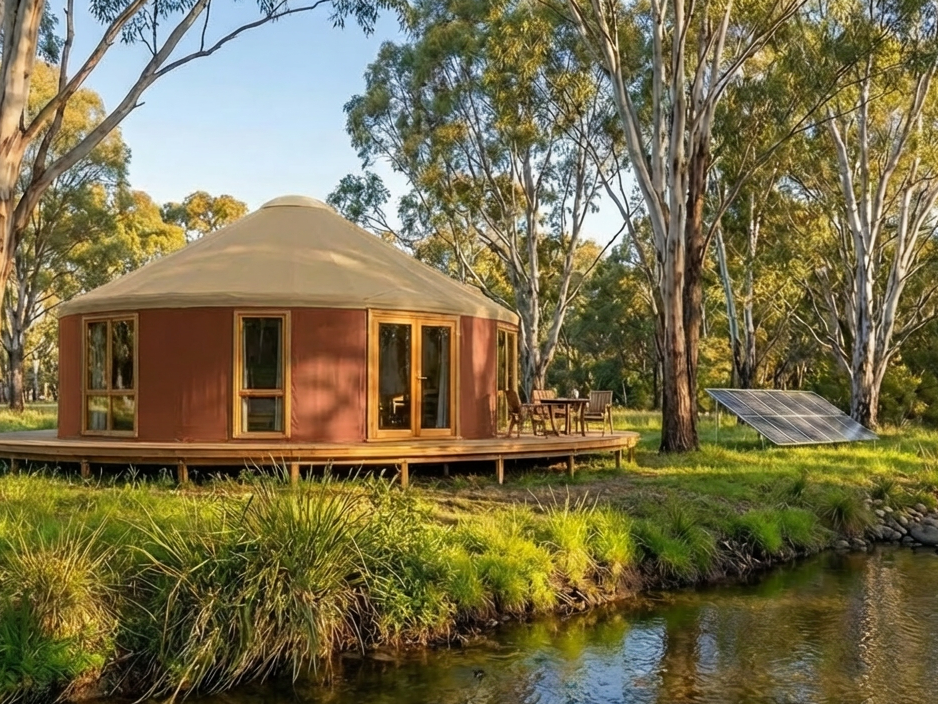
- Describe your land, not just your structure. Hipcamp guests are buying the experience of being on your property. Mention the creek, the native bush, the star-filled skies, the wildlife. This is what sets Hipcamp apart from Airbnb.
- Upload photos that show the setting. Wide landscape shots, the yurt at dusk, the fire pit under the stars — these perform exceptionally well on Hipcamp.
- List your add-ons. Hipcamp makes it easy to offer extras — firewood bundles, farm eggs, guided walks, or kayak hire. These can meaningfully increase your revenue per booking.
- Set clear rules. Hipcamp’s community values leave-no-trace principles. Be explicit about fire rules (especially during fire ban season), pet policies, and quiet hours.
- Connect your calendar to Airbnb. Use iCal sync to prevent double-bookings if you’re listing on both platforms simultaneously.
Fire ban season tip: Hipcamp has a built-in fire ban toggle. When a Total Fire Ban is declared in your state — whether you’re in NSW, VIC, SA, WA, or QLD — you can instantly notify all booked guests with a single click. This is a significant advantage over managing communications manually.
4. Pricing Your Glamping: What to Charge
Pricing is where many new glamping hosts leave money on the table — either by undercharging out of uncertainty, or by overcharging and sitting empty. Here’s how to think about it.
Benchmark rates across Australia (2026)
| Setup Type | Weeknight | Weekend | Peak Season |
|---|---|---|---|
| Basic 4.5m Yurt (no bathroom) | $150–$200 | $200–$280 | $280–$350 |
| 6m Yurt (ensuite, deck) | $200–$280 | $280–$380 | $380–$500 |
| 6m Geo Dome (luxury fit-out) | $250–$320 | $320–$420 | $420–$600 |
| 8m Yurt or Dome (premium) | $300–$400 | $400–$550 | $550–$800+ |
These are indicative ranges based on real client data across NSW, QLD, VIC, WA, and SA. Your actual rate will depend on your location, amenities, proximity to attractions, and the quality of your listing presentation.
Dynamic pricing: work smarter, not harder
Both Airbnb and Hipcamp offer basic dynamic pricing tools, but many experienced hosts use third-party tools like Pricelabs or Wheelhouse to automatically adjust rates based on local demand, competitor pricing, and upcoming events. For a glamping business generating $50,000+ per year, the investment typically pays for itself within the first month.
5. Listing Optimisation: How to Stand Out
With glamping listings multiplying across Australia, a mediocre listing will struggle regardless of how beautiful your setup is. Here’s how to make yours the one that gets clicked — and booked.
Photography: your single biggest lever
Listings with professional photography earn up to 40% more than those with amateur photos. If you can’t afford a photographer, use these principles: shoot during golden hour (the hour after sunrise or before sunset), use a wide-angle lens to show space, and always make the bed properly before shooting. On Airbnb, the cover photo is everything — choose your most striking exterior shot.
The title formula that works
The most effective glamping titles on both platforms follow this structure: [Unique Feature] + [Structure Type] + [Location/Landscape]. For example:
- “Stargazing 8m Dome with Outdoor Bath — Grampians Foothills”
- “Secluded Yurt on 40 Acres — 90 mins from Melbourne”
- “Off-Grid Dome with Fire Pit — Margaret River Wine Region”
Reviews: the compounding asset
Your first 10 reviews are the hardest to get and the most important. Consider offering a small discount for your first few bookings in exchange for an honest review. Once you have a strong review base, your listing will rank higher and attract bookings at full rate. The algorithm rewards review volume, not just score.
6. Marketing Your Glamping Beyond the Platforms
Airbnb and Hipcamp are excellent starting points, but the most profitable glamping businesses in Australia reduce their platform dependency over time by building direct booking channels. Here’s how to start.
-
Instagram and Facebook
Glamping is inherently photogenic. A consistent Instagram presence — posting 3–4 times per week with high-quality images and short reels — can build an audience of potential guests who follow you before they’ve even decided to book. Use location-specific hashtags (#glamping #NSW #yurtlife) alongside broader ones. -
Google Business Profile
A verified Google Business Profile means your glamping property appears in Google Maps searches and local results. This is free, takes about 30 minutes to set up, and can drive significant direct enquiries — especially from travellers already in your region looking for last-minute accommodation. -
Your own direct booking website
Once you’re generating consistent bookings through Airbnb and Hipcamp, consider building a simple direct booking website. Tools like Lodgify or Hostaway integrate with both platforms and allow you to take commission-free direct bookings. At $300 per night, saving even 10–15% in platform fees adds up to thousands of dollars per year.
Want to See a Real Glamping Business in Action?
Read how Stu turned a spare paddock in Victoria into a $300+/night geo dome business — from first build to first booking.
Read Stu’s Story7. The Legal Side: What You Need to Know Before Listing
Before you publish your listing, it’s worth understanding the regulatory landscape. Yurts and geo domes are generally classified as temporary structures in most Australian states, which means they often require less approval than a permanent dwelling. That said, requirements vary significantly between councils.
Council approval: state-by-state overview
| State/Territory | General Approach | Key Consideration |
|---|---|---|
| NSW | Temporary structures often exempt under SEPP (Exempt & Complying) | Check your land zoning — rural/RU1 is most permissive |
| VIC | Planning permit usually required for tourist accommodation | Farm tourism exemptions may apply on agricultural land |
| QLD | Development approval typically required for short-term accommodation | Rural zones (RU) often more straightforward than residential |
| WA | Tourism accommodation requires approval in most zones | Regional councils often more flexible than metro Perth councils |
| SA | Development approval required; Primary Production zones most permissive | Barossa and Clare Valley councils have established glamping precedents |
| TAS | Use Assessment required for tourist accommodation | Rural Living and Primary Industry zones are most accessible |
This table is a general guide only. Always contact your local council directly before investing in a commercial glamping setup. For a deeper dive, read our guide: Can You Live in a Yurt in Australia in 2026? (What Councils Really Allow).
Insurance: don’t rely on platform coverage alone
Both Airbnb’s AirCover and Hipcamp’s host liability insurance provide meaningful protection, but neither is a substitute for a dedicated business insurance policy. If you’re operating commercially, speak with a broker who specialises in tourism and hospitality. Key policies to consider: public liability, property damage, and business interruption insurance.
8. Frequently Asked Questions
Can I list on both Airbnb and Hipcamp at the same time?
Yes, and we recommend it. Use iCal sync to keep your calendars aligned and avoid double-bookings. Many of our clients run both platforms simultaneously and find that Airbnb drives volume while Hipcamp attracts higher-quality, more nature-aligned guests.
Do I need council approval before listing?
Technically, yes — you should have appropriate approvals in place before operating commercially. In practice, many hosts start with a single yurt or dome under temporary structure exemptions. We strongly recommend checking with your local council before investing in a commercial setup.
How much can I realistically earn from a single yurt or dome?
A well-located, well-presented 6m yurt or dome in a popular region can realistically generate $40,000–$70,000 per year at 60–70% occupancy. Our clients in premium locations (wine regions, coastal areas, national park boundaries) regularly achieve $80,000–$100,000+ from a single unit. See our glamping ROI breakdown for detailed numbers.
Which platform charges lower fees?
Airbnb charges hosts approximately 3% (in the host-only fee model), while Hipcamp charges 10%. However, Hipcamp’s guest service fee is lower (~10% vs Airbnb’s ~14%), which means the total cost to the guest is more comparable than the host-side fees suggest. For hosts, Airbnb is cheaper to list on; for guests, Hipcamp is often slightly cheaper to book through.
Is Hipcamp available across all Australian states?
Yes. Hipcamp operates across NSW, VIC, QLD, WA, SA, TAS, ACT, and NT. The platform has been growing rapidly in Australia since its launch here, with particularly strong uptake in regional NSW, the Grampians, and south-west WA.
9. Where to from here?
If you’re still in the planning phase, these are good next steps:
- Read 4 Steps to Launch Your Dream Glamping Business in Australia for a full business planning framework.
- See a real build in action: Stu’s Profitable 6m Geo Dome Build in Victoria — from spare paddock to $300+/night.
- Read Dave’s Off-Grid Yurt Build in Western Australia for an off-grid glamping case study.
- Understand the approvals process with Can You Live in a Yurt in Australia in 2026?
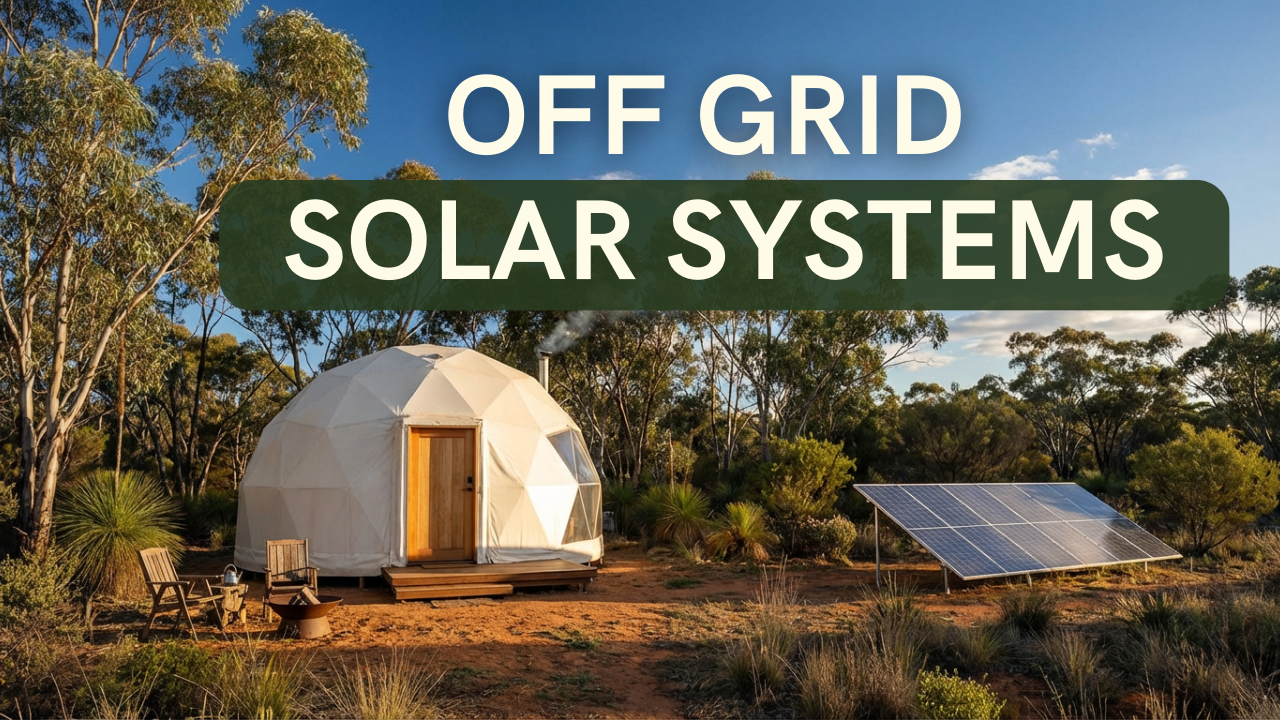
- Plan your power setup with our Off Grid Solar Systems Australia: Yurt & Dome Guide 2026.
If you’re ready to start sketching out a real project, reach out with:
- Your location (state/region)
- How you want to use the space (glamping business, weekender, off-grid home)
- Your target nightly rate and how many units you’re planning
From there we can point you towards a yurt or dome size + setup that’s actually matched to your goals — not just what looks nice on Instagram.
Get the Ultimate Glamping Business Buyers Guide
Everything you need to choose the right yurt or dome, calculate your ROI, and launch your glamping business with confidence. Plus save $500 on your first order.
Download Free Guide 0 Comments
 Share
Share
 By Ryan Smith