hello@yurtinthedirt.com.au
 +61 489 269 088


Last updated: 4 November 2026
What actually makes a cabin off grid, why a round kit suits a remote block, and what the whole setup costs once you add the deck, power and water.
Off-grid cabin in a nutshell
- Off grid means sorting power, water, waste and heating on your own block.
- A round kit needs no slab and no crane, just a solid deck on posts or stumps.
- ORON suits longer stays and living space. A Geo Dome suits guest stays with a view.
- Budget for the deck and power system as well as the kit.
- You can build in stages: deck and kit first, extras later.
- Ask your council about the structure and how you'll use it, before you order.
Before we started Yurt in the Dirt, we spent four years living off-grid as a family in an 8m yurt. So when people ask us about off-grid cabins, we tend to skip the pretty pictures and go straight to the practical stuff: how the building gets to your block, what it sits on, and how you'll power it, heat it and get water to the tap.
What makes a cabin off grid?
A cabin is off grid when it doesn't rely on mains power, town water or sewer. The building is only one part of it. The systems around it decide how comfortable it is to use.
Here's the checklist we'd work through for any off-grid cabin, whatever it's made of:
- Power. Usually solar panels, a battery and an inverter, sized to what you'll actually run. Our off-grid solar guide walks through the sizing.
- Water. A rainwater tank and pump, or a bore if you have one. Work out where the water is collected early, because it affects where the cabin sits.
- Waste. A composting toilet or an approved wastewater system. This one is often a council question, so raise it early.
- Heating and cooling. Insulation does most of the work. See heating a yurt for the winter side.
- Access. Can a ute and trailer get in? It matters on delivery day and every day after.
Get these right and the cabin itself becomes the easy part.
Why use a yurt or dome as an off-grid cabin?
Because the kit is light, it arrives in crates, and it goes up without a slab, a crane or a string of trades. That matters more on a remote block than anywhere else.
A framed cabin out bush usually means footings, framing, roofing, cladding, lining and an electrician and plumber, often with long drives for every trade. A yurt or dome kit packs the frame, covers, insulation, liner and openings into crates. Shipping to the port in Perth, Sydney, Melbourne, Adelaide or Brisbane is already included. From there you can collect from the port warehouse with a suitable trailer, or we can arrange final delivery at an extra cost.
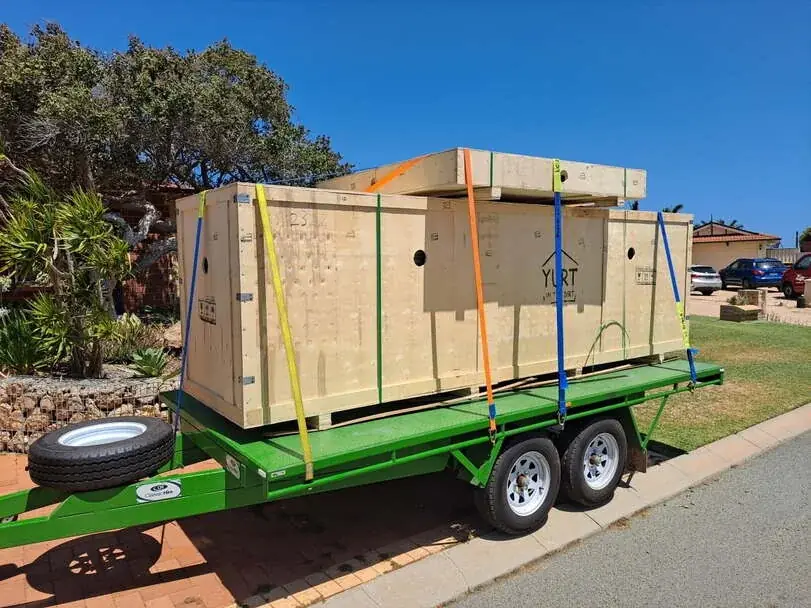
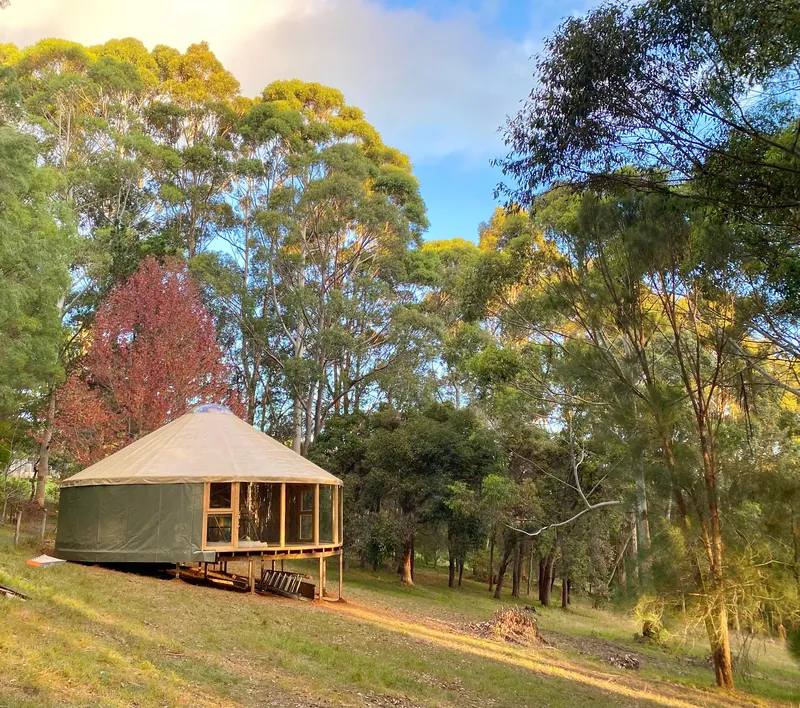
On site, the round building sits on a raised timber deck on posts or stumps. That suits sloping ground and keeps disturbance to a minimum, and the deck stays the same diameter as the yurt or dome. Our platform guide covers the footings and the cost.
A couple of other things suit off-grid life. Once the cover is on, you have a weatherproof room, with no waiting on a roofer or plasterer. And because there's no slab or permanent footing under the walls, the building can come down and go back up on a new deck if your plans change.
Is an ORON yurt a good off-grid cabin?
Yes. ORON is the one we'd point you to if you'll be spending real time in it, whether that's weekends, long stays or a studio you use every day.
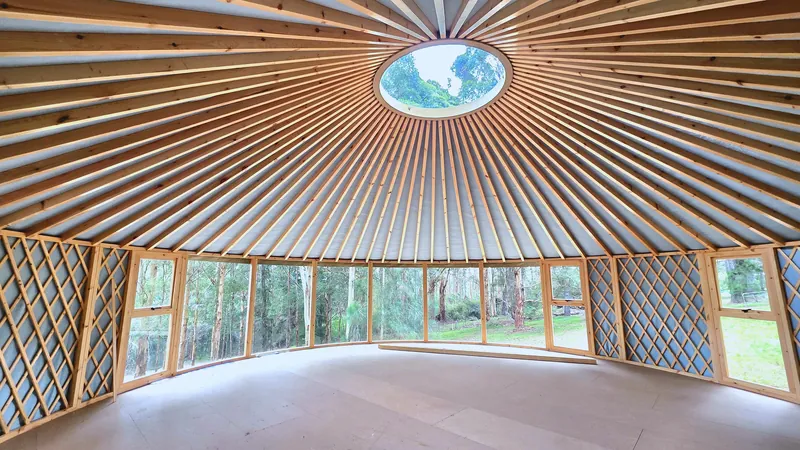
ORON is our premium yurt. It has a handmade timber frame that's 60% heavier than our Standard yurts, and the kit includes a hardwood door (seven styles) and a full-height opening window. Durable matte-finish outer covers come in five natural colours inspired by the landscape: Sand Dune, Bushland, Riverstone, Red Ochre and Deepwater. Mix the roof and wall colours and it settles into a bush or farm block rather than standing out.
For an off-grid cabin, the parts that matter most are the ones that keep heat in without power:
- 10mm wool felt insulation as standard, with a second felt layer for cold winters for $750, or a reflective air-cell layer for hot summers for $750.
- A breathable hemp-cotton interior liner, in nine colours.
- A dome skylight overhead, 10mm thick acrylic in clear or tinted, so the room stays bright through the day without switching anything on.
| ORON size | Floor area | Kit price |
|---|---|---|
| 5m | 20 sqm | $14,350 |
| 6m | 30 sqm | $16,490 |
| 7m | 40 sqm | $18,980 |
| 8m | 50 sqm | $20,980 |
| 9m | 63 sqm | $27,900 |
| 10m | 80 sqm | $32,090 |
| 12m | 100 sqm | Price on application |
Not sure which diameter fits your plans? The ORON size guide lays out what fits in each one. Through the free Buyer's Guide you can also unlock 10% off ORON and a free upgrade to hardwood doors and windows.
When does a Geo Dome make more sense?
When the view is the point, or you're setting up a guest stay. About a third of a Geo Dome is a clear panoramic section, so you see the paddock or the bush from bed.
The frame is hot-dip galvanised steel. Inside, an insulated canvas lining is backed by a double layer of aluminium air-cell insulation as standard. Two opening porthole windows with insect screens let air through, and a solar ventilation fan draws hot air out without needing separate power, which is handy when every watt counts. The clear section is removable, so down the track you can replace just that piece.
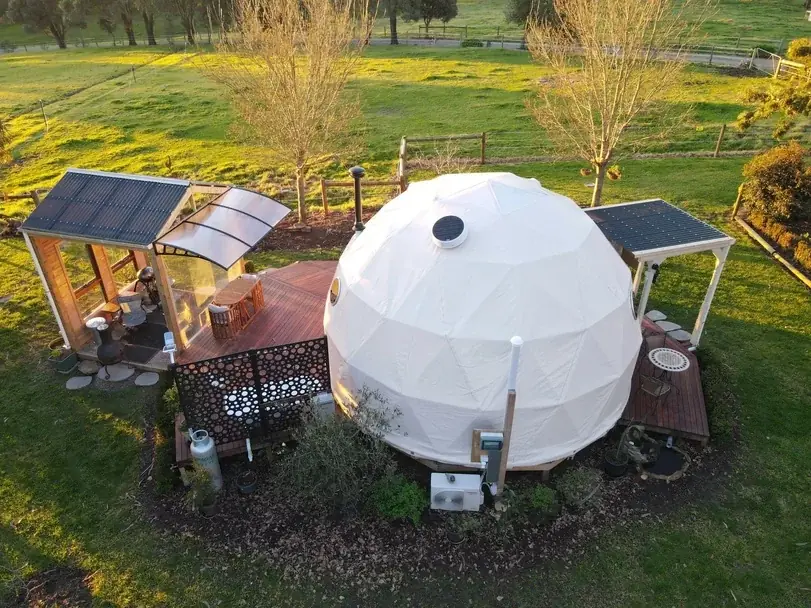
Geo Domes run from $14,490 for a 5m to $26,490 for a 10m, ex GST, and a double glazed glass front is available as a paid upgrade. If you're torn between the two, we usually suggest a yurt for full-time living space, because furniture and a kitchen sit more easily against its walls. For a guest stay or retreat it's a closer call. Our glamping dome sizes guide goes through what each diameter suits.
How much does an off-grid cabin cost?
Add up five things: the kit, the deck, the power system, water and waste, and the fit-out. The kit is often less than half of the total.
| Part of the build | Typical range | Where the number comes from |
|---|---|---|
| ORON kit | $14,350 to $32,090 ex GST (5m to 10m) | ORON page |
| Geo Dome kit | $14,490 to $26,490 ex GST (5m to 10m) | Geo Domes page |
| Standard yurt kit | From $11,000 ex GST (4.5m) | Standard Yurts page |
| Timber deck | $5,000 to $15,000 for most DIY decks | Platform guide |
| Off-grid solar | About $1,500 (DIY weekend setup) to $20,000+ (installed, full-time family) | Solar guide |
| Water, waste and fit-out | Depends on your site and how you'll use it | Get local quotes |
For a real number, look at Dave's 8m Standard yurt in the WA Wheatbelt. It runs fully off grid, with a mezzanine bedroom, bathroom and kitchen, and his total came to about $37,000 at 2025 prices: $16,500 for the kit and extra windows, $8,000 for decking, $5,000 for the fit-out, $5,000 for solar and $2,500 in sundries. Dave's build story has the full breakdown. Today's kit prices are on the product pages.
If you'd rather spread the kit cost out, finance for eligible buyers usually starts around $500 a month. For a wider look at the budget, see how much a yurt costs.
Is it legal to live off grid in Australia?
There's no single yes or no. What usually needs checking is the structure itself and how you plan to use it.
Rules vary by state, region and council, and by use: a guest stay, a studio or somewhere to live are all treated differently. Rural and off-grid properties tend to face fewer restrictions than suburban blocks, but for residential use, yurts and domes don't currently comply with building standards. Living in one doesn't mean it's approved as a permanent dwelling. Talk to your council before you order. Our council approval guide and can you live in a yurt go into the detail.
How hard is it to build one yourself?
The deck is the biggest job. The yurt or dome itself usually takes two to three days with a few helpers.
A first ORON build typically takes two to three days with two to four people for the smaller sizes, and four or more for the bigger ones. You get size-specific decking plans, video instructions and our team on the phone when you're stuck. On a remote block, plan around one thing: get every tool and fixing on site before build day, because the hardware store might be an hour away.
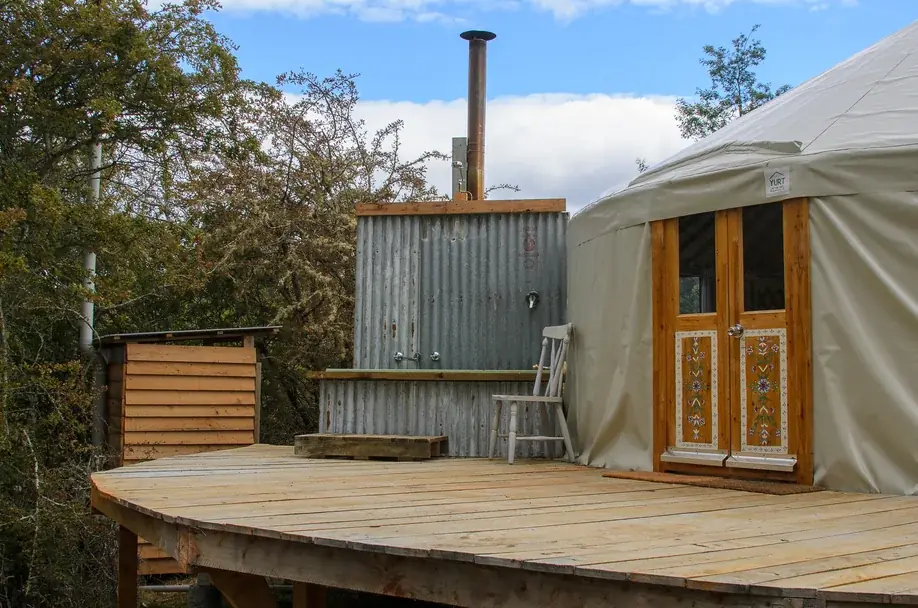
You don't have to take our word for it. Here's what two off-grid clients said in their Google reviews:
"It took about 2 days to build with the help of 6 friends. The instructional video was easy to follow and Ryan was a big help... I'm fully off grid in Tasmania."
Flora Swift, 5.2m Standard yurt, Tasmania
"The 7m ORON Yurt gave us the flexibility to build the project in stages without taking on another major renovation... The yurt sits in a beautiful, secluded part of our property and is going to become a peaceful off-grid eco retreat with an outdoor bath and fire pit."
Glover family, 7m ORON, Tamworth NSW
Plenty of our clients across Australia and NZ are happy to show their builds, and their video reviews are on the ORON page. The platform guide covers the deck, and how to build a yurt covers the rest.
Frequently asked questions
Can you get a yurt or Geo Dome to a remote block?
Yes. Your kit price already covers freight to the nearest major port, whether that's Perth, Sydney, Melbourne, Adelaide or Brisbane. From there, bring a suitable trailer and pick the crates up yourself, or we can organise the last leg to your block for an extra cost. Tasmanian orders go via Melbourne and carry an additional shipping fee, confirmed with your quote.
Can I build an off-grid cabin in stages?
Yes. You can put in the deck and kit first, so you have a weatherproof room, then power, water and the fit-out as time and budget allow. The Glover family in Tamworth built their 7m ORON in stages for exactly that reason.
What's the difference between an off-grid cabin and an eco cabin?
Off grid is about services: your own power, water and waste. Eco is about the building's footprint and materials. A yurt can tick both boxes. ORON uses a timber frame, wool felt insulation and a hemp-cotton liner, and it sits on a raised deck instead of a slab.
Does a Geo Dome need power for ventilation?
No. Every Geo Dome comes with a solar ventilation fan that draws hot air out without a separate power supply, plus two opening porthole windows. Extra solar vents can be added.
Which colour suits an off-grid block?
That comes down to what's around it and whether you want the cabin to blend in or stand out. ORON covers come in Sand Dune, Bushland, Riverstone, Red Ochre and Deepwater, and the roof and walls can be different colours. Screens never show fabric colour quite right, so look at client photos and videos before you decide.
Planning an off-grid cabin?
Tell us about your block, how you'll use the space and where you are, and we'll quote an ORON or Geo Dome for it. The free Buyer's Guide unlocks 10% off ORON, $500 off any yurt or Geo Dome and a free upgrade to hardwood doors and windows.