hello@yurtinthedirt.com.au
 +61 489 269 088


Last updated: 23 November 2026
How a traditional Mongolian ger is built and lived in, what a modern yurt like ORON keeps from it, what it swaps out, and which one makes sense on an Australian block.
The short version
- Ger is the Mongolian word. Yurt is the name English uses.
- The bones haven't changed: lattice wall, roof poles, a crown and a tension band.
- A ger is designed to come down and move. A modern yurt is designed to stay up.
- Felt still matters. ORON has 10mm high-density wool felt as standard.
- Glass, hardwood joinery and a raised deck are the big modern additions.
If you've been searching for a Mongolian yurt, you've probably wondered how close a modern kit is to the real thing. The short answer: close in shape, different in nearly everything that touches the weather. Our yurts are descendants of the ger, not copies. The circle, the lattice and the crown come straight from the steppe, while the frame, the openings and the cover have been rethought for a building that stays on one Australian block for years. Here's what the original looks like, what changed, and how to work out which one you actually want.
What is a Mongolian yurt?
It's the portable round home of Mongolia's herding families, known there as a ger, and it has been refined over many centuries to be put up, taken down and carried to new pasture.
Ger simply means home. "Yurt" is the word that reached English by way of Russian, so when you search for a Mongolian yurt, a Mongolian ger or a Mongolian tent, you're looking at the same structure under three names. Calling it a tent undersells it a little. A ger has a rigid wooden skeleton and thick felt walls, and families live in one through winters far colder than anything we get here.
They aren't museum pieces either. Many Mongolian families still live in gers, both out on the steppe and in the ger districts that ring Ulaanbaatar. For a herder who moves with the seasons, nothing else packs down as neatly or goes back up as quickly.
What is a traditional ger made of?
A ger is made of five things: a lattice wall, roof poles, a crown, felt and an outer canvas, all held together by rope and tension rather than nails.
- Khana (the wall). Sections of willow lattice that fold up flat for travel and open out into a circle. The number of sections sets the size of the ger.
- Uni (the roof poles). Dozens of slim, often brightly painted poles, each tied to the lattice at one end and slotted into the crown at the other.
- Toono (the crown). A wooden ring at the top that lets smoke out and daylight in. In many gers it rests on two posts, the bagana, standing near the stove.
- Felt. Sheets of pressed sheep's wool wrapped around the walls and roof. Families add layers for winter and take them off again when it warms up.
- Canvas and rope. A cotton outer cover goes over the felt, and ropes bind the whole thing tight against the wind.
The clever part is the tension. The roof poles push outwards on the lattice, a band around the top of the wall pulls it back in, and the forces balance. That's why a ger can stand without fixings into the ground, and it's the same principle every modern yurt still relies on. If you'd like the layer-by-layer detail for a modern kit, our guide to what a yurt is made of covers it.
How is a ger lived in?
A ger is one round room with a stove in the middle, a low door facing south and a layout that follows long-held custom.
The stove sits at the centre with its flue rising through the crown, so heat spreads evenly to the walls. The door faces south, towards the sun and away from the coldest winds, and it's low enough that most adults duck on the way in. The back of the ger, opposite the door, is the place of honour, where guests of standing and family keepsakes go. Beds and storage line the walls, and the floor is covered in felt and rugs.
A ger is also built to travel. Herding families move between seasonal pastures, and an experienced family can take a ger down, load it and put it back up in a matter of hours. Everything about it, from the folding lattice to the rope binding, serves that one job.
What makes a yurt "modern"?
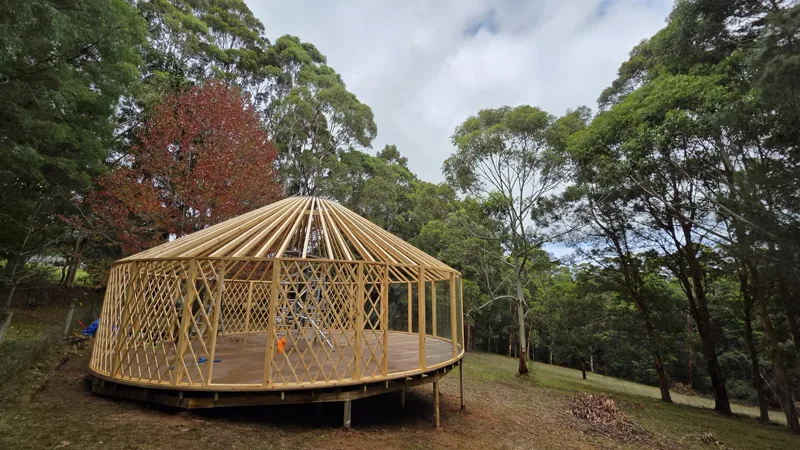
A modern yurt is built to stay in one place, so it can carry heavier timber, real glass, a proper floor and a cover that sheds rain for years.
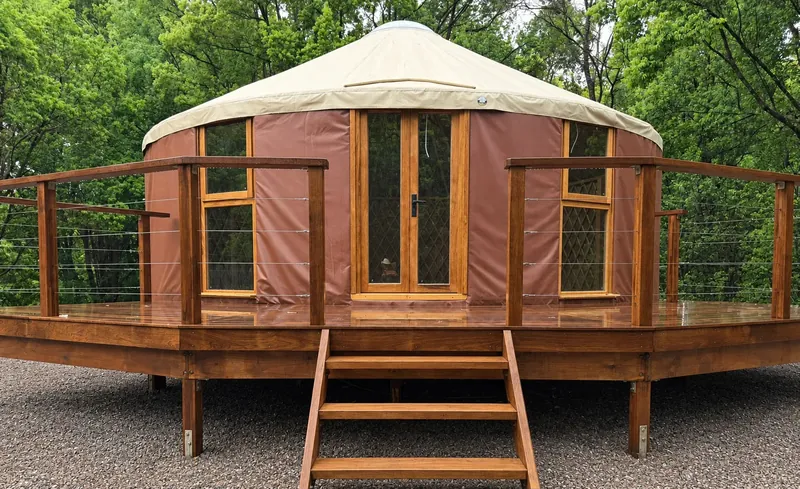
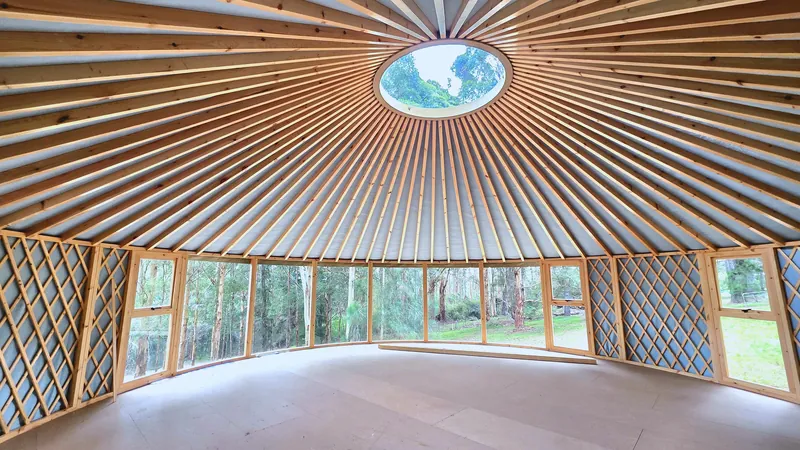
Once you stop moving a yurt every few months, the weight limit disappears. That one change explains most of the differences. With ORON, the frame is solid timber and about 60% heavier than our Standard Yurt's. The doors and windows are hardwood with toughened glass, in seven door styles, and every kit includes one full-height opening window. The crown becomes a skylight of 10mm thick acrylic, clear or tinted, so you see the sky rather than a smoke hole.
The floor lifts off the ground onto a timber deck built to the yurt's diameter. We supply decking plans for each size, and our yurt platform guide explains the options. The outer cover is a durable matte-finish cover in five natural colours inspired by the landscape: Sand Dune, Bushland, Riverstone, Red Ochre and Deepwater. Inside, a breathable hemp-cotton liner sits behind the lattice and rafters, in nine earthy colours.
What a modern yurt gives up is portability. An ORON can come down and go back up somewhere else, but expect a few days with helpers, not a morning's work for a family.
How do they compare side by side?
The shape is the same. The materials, the floor and the expectations are different.
| Traditional Mongolian ger | ORON modern yurt | |
|---|---|---|
| Built for | Moving with the seasons | Staying up for years on one site |
| Wall | Folding willow lattice | Solid timber lattice |
| Roof | Painted poles to a wooden crown, often on two centre posts | Timber rafters to a centre ring, with a 10mm acrylic skylight |
| Insulation | Layers of sheep's wool felt, added for winter | Wool felt as standard, plus an optional extra layer for cold sites or Air-Cell for hot ones |
| Outer layer | Cotton canvas, tied with rope | Waterproof, UV-resistant matte-finish cover in five colours |
| Door | Low, painted timber, facing south | Hardwood, 900mm opening, seven styles |
| Windows | Usually none | One opening window included, more and curved glass optional |
| Floor | Felt and rugs over the ground | Timber deck to the yurt's diameter |
| Wall height | Low | 1.9m (5m to 8m) or 2.1m (9m and 10m) |
What does ORON keep from the ger?
More than you might expect: the round plan, the lattice, rafters meeting at a crown, the tension that holds it all together, wool felt in the walls and even the name.
ORON (орон) is a Mongolian word for a place or dwelling. We chose it on purpose. The design came out of years spent living in and building yurts, and the aim was never to replace the old idea, only to make it stronger and more comfortable for a building that doesn't move.
Wool felt is the clearest link. Herders have trusted it for centuries because it holds warmth and breathes. ORON keeps it, as 10mm high-density felt under the outer covers. For a cold site you can add a second felt layer. For a hot one, reflective Air-Cell over the felt helps cut radiant heat. Our post on whether yurts are hot in summer or cold in winter goes further into choosing between them.
Glen Mitchell, who is building a group of yurts for an eco-retreat in the South West of WA, put the difference between our older model and ORON this way in his review: "the quality is exceptional and a huge step up from the earlier model which we already loved." You can see the finished result for yourself in the Muñoz family's 8m ORON build in the Northern Rivers, NSW, and the Glover family's 7m ORON in Tamworth, NSW, which they built in stages.
Would a traditional ger suit Australian conditions?
It can, if you love the tradition and accept how it's designed to work, but it was built for a dry, cold climate and a life on the move.
A ger shines on the open steppe: cold winters, dry air, and a family who will pack it up again in a few months. Plenty of Australian blocks ask different things of a building. Here's what we'd think through before choosing either style.
- Rain and humidity. Felt keeps you warm when it's dry. In a wet or humid spot it needs to be able to dry out, so the outer layer and the airflow matter a lot.
- Heat. In summer, Mongolian families roll up the bottom of the felt walls to let air through. On a hot Australian afternoon, opening windows, shade and the right insulation do a similar job.
- Light and view. A traditional ger relies on the crown and the open door for light. If the view is the reason you bought the land, you'll want glass.
- How long it stays. If you'll move it often, a lighter ger makes sense. If it's staying put as a studio, guest stay or place to live, a heavier frame on a deck will serve you better.
- Heating. A centre stove is the ger tradition. If you want a wood heater in a modern yurt, our guide to heating a yurt covers placement and safety.
Whichever you choose, talk to your local council early about your block and how you plan to use the yurt. Rules vary from place to place.
What does a modern yurt cost here?
ORON kits run from $14,350 for a 5m to $32,090 for a 10m, AUD ex GST, and freight to your nearest major port is part of that price. The 12m is quoted on request.
We don't sell traditional gers, so we won't guess at anyone else's prices. Here's ours, from the live ORON page.
| ORON size | Floor area | Kit price (AUD ex GST) |
|---|---|---|
| 5m | 20 sq m | $14,350 |
| 6m | 30 sq m | $16,490 |
| 7m | 40 sq m | $18,980 |
| 8m | 50 sq m | $20,980 |
| 9m | 63 sq m | $27,900 |
| 10m | 80 sq m | $32,090 |
| 12m | 100 sq m | On enquiry |
The kit covers the frame, covers, wool felt, hemp-cotton liner, skylight, one hardwood door and one opening window. Extra opening windows are $890 each and curved fixed glass is $1,250 a panel. Freight to the port in Perth, Sydney, Melbourne, Adelaide or Brisbane is included, and Tasmanian orders carry an extra shipping fee that we confirm with your quote. The deck, flooring, fit-out and services are separate. For a full budget, see what a premium yurt costs in Australia, and if you're stuck between sizes, the ORON size guide helps.
Every ORON comes with a 3-year warranty on the frame and cover against defects in materials and workmanship. The outer cover is the part that wears. Plan on replacing it roughly every 7 years, from around $3,000 delivered depending on size, while the frame carries on. You'll also get the same build support our other clients use: size-specific decking plans, assembly videos and a phone call whenever you're stuck. We're 4.9 on Google, and plenty of our clients are happy to show you their yurts.
If you'd like something lighter and simpler, our Standard Yurt is the other option in our range. And if what draws you in is the view more than the tradition, a Geo Dome may suit you better.
Frequently asked questions
What does "ger" mean?
Ger is the Mongolian word for home. It names the same round, felt-covered dwelling that English calls a yurt, so ger, yurt and Mongolian tent all describe one structure.
What does the name ORON mean?
ORON (орон) is a Mongolian word for a place or dwelling. We named our premium yurt after it as a nod to where the design comes from.
Why do Mongolian gers face south?
Facing the door south lets in the sun and turns the back of the ger to the coldest winds. In Australia the sun sits to the north, so if you want the same effect, put your glass on the north side.
Does a traditional Mongolian ger have a bathroom?
No. A traditional ger is one room for living, cooking and sleeping, and washing and toilets are outside. A modern yurt can take a bathroom inside. The ORON brochure shows an 8m layout with one, though plumbing sits outside the kit.
How often do Mongolian families move their ger?
Herding families usually move between seasonal pastures, often several times a year, and some move more often depending on grazing and weather. Families living in town keep theirs in one place.
Do you sell traditional Mongolian yurts?
No. We sell modern yurts, ORON and our Standard Yurt, plus Geo Domes. ORON is the closest to the ger in spirit, with a timber lattice and wool felt insulation, but it's built to stay on a deck rather than move with the seasons.
Drawn to the round home?
Send us a few lines on the site, what the yurt will be used for and roughly what size you're after. We'll come back with an ORON quote built around it. The free Buyer's Guide unlocks 10% off ORON, $500 off any yurt or Geo Dome and a free upgrade to hardwood doors and windows.